Authors : Waode Surya Darmadali, S.S., M.Hum
Speaking ability in English remains one of the main challenges for students in EFL (English as a Foreign Language) contexts. Although students have studied English for many years, many of them still struggle to express their ideas orally. Common problems include limited vocabulary, weak grammatical competence, inaccurate pronunciation, and low self-confidence when speaking. These conditions directly affect students’ performance in regular classes and hinder their ability to communicate effectively.
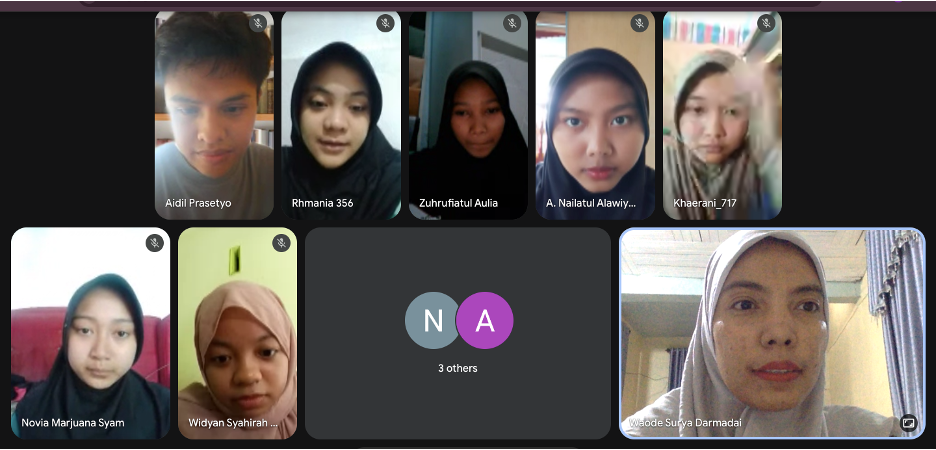
In response to these issues, an additional program entitled Online Speaking Clinics for Students’ Fluency Development was designed to provide special support for students who need reinforcement in their speaking skills. The program was attended by AG1 students in the Academic Year 2025 who were identified as having difficulties in speaking. The activities were conducted in 10 sessions, combining synchronous and asynchronous online learning to accommodate geographical constraints and students’ time flexibility. Before the program began, the lecturer conducted initial interviews with all participants to map their basic speaking abilities. The interviews were conducted via Google Meet and consisted of simple questions aimed at measuring vocabulary mastery, pronunciation, and grammatical accuracy. The results showed that most students experienced anxiety when speaking, often hesitated in choosing words, and were not yet able to construct grammatically correct sentences. This initial data became the basis for designing the learning materials and strategies throughout the program.
During the implementation of the Online Speaking Clinics, the learning materials were designed to be practical and contextual so that they were easy to understand and relevant to students’ daily communication needs. One of the main focuses was practicing how to describe people, such as age, appearance, and physical characteristics. This topic was chosen because it allows students to practice basic vocabulary while building simple sentence structures in real communicative situations. In addition, students also learned the differences in the use of pronouns (subject, object, and possessive pronouns), which had previously been a common source of errors. Exercises on cardinal and ordinal numbers were also provided through guided speaking activities, such as introducing family members or explaining the sequence of activities.
The learning approach emphasized active participation and supportive feedback. Students were encouraged to speak as much as possible without being afraid of making mistakes. Corrections were given constructively, focusing on clarity of meaning and communicative fluency rather than mere grammatical perfection. A safe and non-judgmental classroom atmosphere made students more willing to try, experiment with the language, and gradually build their self-confidence. The results of this additional class showed very positive impacts. Linguistically, students experienced improvements in vocabulary mastery, clearer pronunciation, and more accurate use of grammar. However, the most significant change was seen in the affective aspect, particularly self-confidence. Students became more confident in speaking, more active in discussions, and less afraid of making mistakes. Many participants stated that they felt more comfortable using English, both inside and outside the classroom.
In addition to improving language competence, the program also had important psychological effects. A supportive learning environment helped reduce students’ anxiety and changed their perspectives on learning to speak. Students began to see mistakes as part of the learning process rather than as failures. This change in mindset is crucial in language learning, as motivation and self-confidence are key factors in the development of communicative competence. Based on the evaluation and monitoring results, several recommendations can be made for future program development. First, the clinic classes should be scheduled after final exams or during relatively less busy academic periods to avoid overburdening students. Second, although online learning proved effective, the number of participants should be limited so that each student has optimal opportunities to speak. Third, it is recommended to organize a speaking competition in the middle of the semester as a motivational tool as well as a way to identify students with potential to participate in regional, national, or international competitions.
Overall, the Online Speaking Clinics demonstrate that well-structured, communicative, and needs-based additional classes can be an effective strategy to improve students’ speaking skills. This program not only strengthens linguistic aspects but also builds self-confidence and positive attitudes toward learning English. This initiative is expected to become an alternative learning model that can be adapted and developed in various study programs and educational institutions.